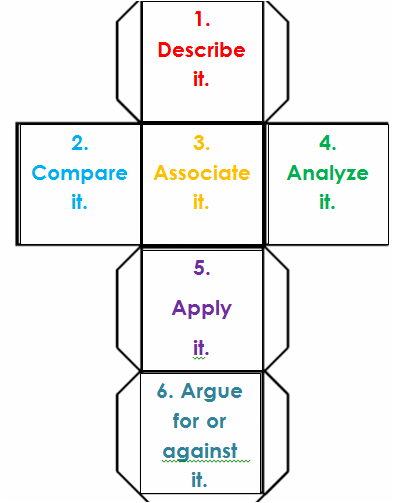
Cubing: This technique helps you look at your subject from six different points of view (imagine the 6 sides of a cube and you get the idea). Take your topic or idea and
1) describe it,
2) compare it,
3) associate it with something else you know,
4) analyze it (meaning break it into parts),
5) apply it to a situation you are familiar with,
6) argue for or against it.
Write a paragraph, page, or more about each of the six points of view on your subject.
Shifting viewpoints (role-playing): When you begin to feel you have some understanding of your idea, it sometimes helps to look at it from another person’s point of view. You can do this by role-playing with someone who disagrees with your conclusions or who has a different set of assumptions about your subject. Make a list or write a dialogue to begin to reveal the other perspective.
Applying an idea to a new situation: If you have developed a working thesis, test it out by applying it to another event or situation. If your idea is clear, it will probably work again, or you will find other supporting instances of your theory.
Problem/Solution writing: Sometimes it helps to look at your ideas through a problem-solving lens. To do so, first briefly outline the problem as you see it or define it. Make sure you are thorough in listing all the elements that contribute to the creation of the problem. Next, make a list of potential solutions. Remember, there is likely to be more than one solution.
Theory/application writing: If your assignment asks you to develop a theory or an argument, abstract it from the situation at hand (in other words, keep your argument in mind as you read through the text). Does your theory hold through the text? Would it apply to a new situation, or can you think of a similar situation that works in the same way? Explain your ideas to a friend.
Defining critical questions: You may have lots of evidence or information and still feel uncertain about what you should do with it or how you should write about it. Look at your evidence and see if you can find repeated information or a repeated missing piece. See if you can write a question or a series of questions that summarize the most important ideas in your paper. Once you have the critical questions, you can begin to organize your ideas around potential answers to the question.
Explaining/teaching your idea to someone else: Sometimes the most efficient way to clarify your ideas is to explain them to someone else. The other person need not be knowledgeable about your subject—in fact, it sometimes helps if they aren’t familiar with your topic—but should be willing to listen and interrupt you when he or she doesn’t follow you. As you teach your ideas to someone else, you may begin to have more confidence in the shape of your ideas, or you may be able to identify the holes in your argument and be more able to fix them.


 Burns Tutoring
Leave a comment